









Climate has shaped roof design for more than 1,000 years
By Emma Peterson.
By examining centuries-old buildings and historical climate records, researchers found evidence that roof geometry evolved alongside changing snowfall conditions.
As weather events continue to grow in extremity, there’s a lot of discussion going on about how we can build structures stronger so that they can withstand the elements. This can seem like an overwhelming task, but it might be one that humans have already overcome in the past.
Research published in the journal Science Advances points to a connection between China’s historical roofs and changing snowfall patterns. This research was conducted by a team from 南京 (Nánjīng) University that included Siyang Li, Ke Ding, Aijun Ding, Lejun He, Xin Huang and Congbin Fu in collaboration with Quansheng Ge of the Chinese Academy of Science in 北京 (Běijīng).
Collecting the data
To set up their study, the team began with field research. As an EOS article by Katherine Kornei describes:
The team amassed records of roughly 200 wooden buildings constructed in northern China from the 8th to 18th centuries (from the middle to late 唐 [Táng] dynasty to the middle of the 清 [Qīng] dynasty)... For each building, the researchers calculated the ratio of its roof’s height to its span.
The reasoning behind collecting that ratio was that roof slope is a trackable change in construction design that could show a correlation between construction and weather changes (a steeper slope is better at shedding precipitation like snow).
After collecting the data on the different buildings, the team turned to historical weather data. As Katherine wrote, “To infer what the climate was like in northern China from the 8th to 18th centuries, the team mined published paleoclimatic reconstructions.” In other words, the team used historical documents and data to understand weather anomalies in Northern China between the 8th to 18th centuries with a special focus on snowfall anomalies.
The connections
With their data collected, the researchers began putting the puzzle pieces together. And what they found was “that the main factor driving the modification of roof pitch and curvature of official buildings was the fluctuation in snowfall intensity associated with climate change over the past thousand years.”
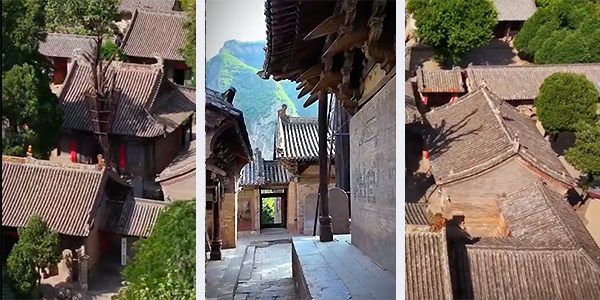
In the study, they highlighted 龙门(Lóngmén) Temple in the 山西 (Shānxī) province as an individual case study supporting this connection between roof design and weather. As written in the study:
According to the historical document of building standards of the Song Dynasty (Yingzao fashi, 1103 CE) (36), [the buildings] in the Lóngmén Temple were supposed to have a nearly identical roof pitch of ~27%. However, the two buildings constructed in cold periods presented steeper roofs, at 29.67% (1098 CE) and 30.50% (1498–1504 CE), whereas the one in the warm period was smoother, at 26.92%.
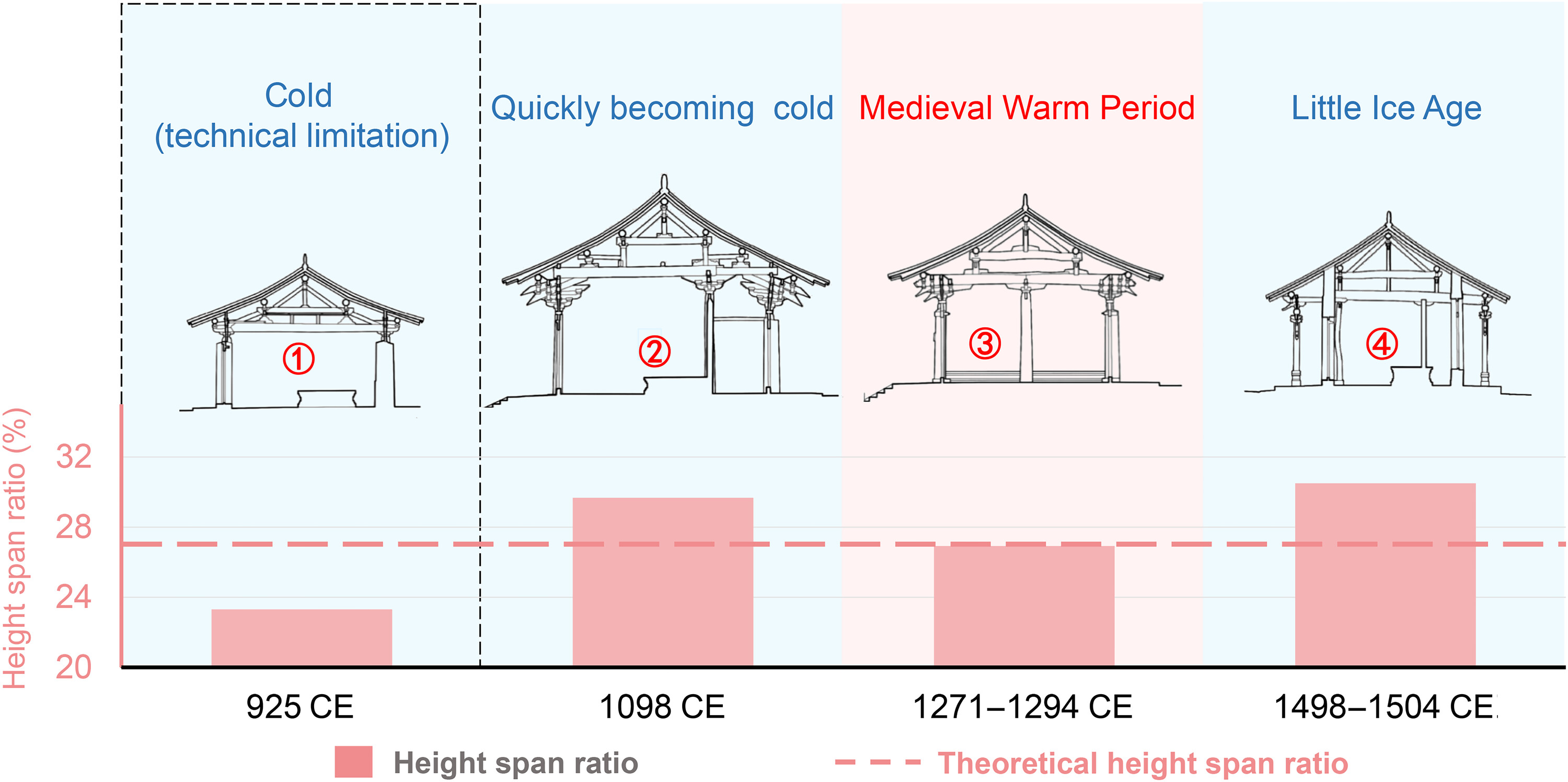
This is a perfect illustration of the larger pattern found by the group – that historical Chinese architects built roofs in response to the weather patterns experienced during the construction period.
Further, this example showcases how we know that the steeper slopes were due to historic snowfall rather than other forms of precipitation like rain. As Ke Ding told EOS, “If the roof [slope] changed according to rainfall, it should be steeper in warmer periods.” And, as roofs like those Lóngmén Temple, changed during the cold periods, it can be concluded that snowfall was the primary precipitation impacting the construction methods.
Beyond this study
Overall, this study showcases the resilience of roofers and humans in general to adapt to changing environments. As Katherine put it, “Given the rapid climate change the planet is currently experiencing — [the fact that] people in the past made changes [is heartening and a testament to our current capability] of doing the same.”
Image sources in order of appearance: People’s Daily, Science Advances
Stay up to date with the latest industry news when you sign up for the Coffee Shop eNews.
Recommended For You
Beat the heat with silicone roof coatings
Read More ...
SPRI Adds New Environmental Product Declarations Section to its Website and Posts New EPDs From Several Member Companies
Read More ...
Joining the growing solar market
Read More ...
UP TO THE MINUTE







Comments
Leave a Reply
Have an account? Login to leave a comment!
Sign In