









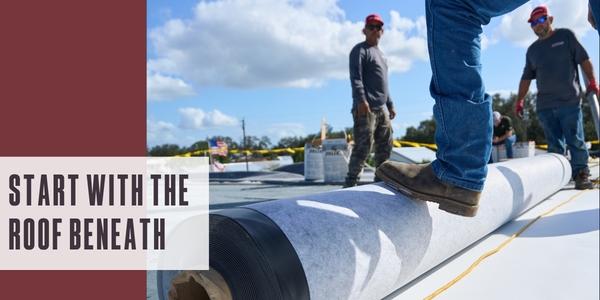
Start with the roof beneath
By Jesse Sanchez.
Careful roof evaluation, proper adhesive handling and contractor training are essential to successful fleece back recover projects.
Fleece back membranes can streamline recover projects, but the existing roof must provide a sound foundation for the new system. In this episode of Roofing Road Trips®, host Karen Edwards spoke with MuleHide’s Tony Vieira about the conditions contractors should evaluate before recommending a fleece back recover.
Moisture is one of the most important considerations. Wet or water-damaged insulation should be removed and replaced, and extensive damage may make a tear-off the more practical approach. Tony said moisture surveys can help identify affected sections without disturbing the roof. He explained, “Wet damaged or wet areas of insulation can be determined just by a moisture survey. It’s a non-invasive way to see if there’s wet areas in that roof that could potentially need to be removed and replaced.”
The condition and attachment of the existing membrane also matters because the recover system depends on the roof below it. Loose membranes must be secured, and MuleHide requires an existing system to be fully adhered for a direct recover. Tony cautioned against installing directly over mechanically fastened, ballasted or gravel-surfaced built-up roof systems. Existing polyvinyl chloride (PVC) membranes are also excluded from the direct-recover applications discussed in the episode.
Contractors must also confirm how many roof systems are already in place. Tony explained, “Building code generally states that you can have two roof systems in place. You can’t put a third one on top.” This generally prevents a third system from being installed as a recover.
Once a roof is approved, proper low-rise foam adhesive application becomes critical. The two-component adhesive must be stored at an appropriate temperature, mixed correctly and allowed to foam before the membrane is placed. Tony recommended checking the adhesive with a gloved hand for strings that resemble a “cheesy quesadilla,” indicating it is within the application window.
Training helps contractors recognize those conditions and avoid adhesive that is still wet or has become too dry. Contractors seeking approval to install warranted MuleHide systems must coordinate with their local representative and complete certification training.
Learn more about MuleHide Products in their Coffee Shops Directory or visit www.mulehide.com.
About the author

Jesse is a writer for The Coffee Shops. When he is not writing and learning about the roofing industry, he can be found powerlifting, playing saxophone or reading a good book.
Recommended For You
Roof deck damage dissected
Read More ...
Setting yourself up for coatings success
Read More ...
Protection beneath every roof
Read More ...
UP TO THE MINUTE







Comments
Leave a Reply
Have an account? Login to leave a comment!
Sign In