










Federal policy, workforce and elections take center stage at SPRI Annual Meeting 2026
By Heidi J. Ellsworth.
NRCA’s Duane Musser outlines tariffs, tax victories, regulatory shifts and political outlook.
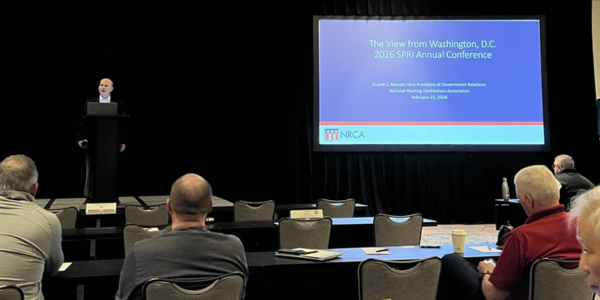
At the 2026 Annual Meeting of the Single Ply Roofing Industry (SPRI), attendees received a comprehensive federal policy update from Duane Musser, vice president of government affairs for the National Roofing Contractors Association. His presentation addressed tariffs, tax legislation, regulatory developments, workforce initiatives, immigration policy, energy incentives and the political outlook heading into the 2026 elections.
Musser began with tariffs, noting the U.S. Court of International Trade ruled IEEPA tariffs unconstitutional and the decision pending on appeal before the Supreme Court (subsequently the Supreme Court has ruled to uphold the lower court ruling that IEEPA tariffs are invalid). He noted that in the event that the ruling stands, the administration has alternative options available on tariffs. Negotiations on trade deals with various countries continue and the U.S.-Mexico-Canada Trade Agreement is up for renewal in 2026. The House has also voted to allow resolutions to nullify tariffs, creating continued uncertainty for contractors managing material pricing and supply chains.
Turning to tax policy, Musser outlined NRCA wins secured through passage of the One Big Beautiful Bill Act. Among the most significant victories for roofing contractors is the continuation of the Section 199A deduction for pass-through businesses, a critical provision for companies structured as S corporations, partnerships and sole proprietorships. The legislation also preserved the 21 percent corporate tax rate and maintained the 37 percent top individual rate, providing stability for long-term business planning. Additional wins included maintaining estate tax exemption levels, preserving full expensing for nonresidential roofs under Section 179 and restoring favorable treatment for research and development costs. Musser emphasized that these outcomes reflect years of sustained advocacy by NRCA to protect pro-growth tax policies for contractors nationwide.
On regulatory issues, Musser reinforced that minimizing regulatory burdens remains central to NRCA’s agenda. With the Trump administration pursuing deregulation, the Department of Labor is expected to modify certain Biden-era rules. However, Occupational Safety and Health Administration activity remains active, including a proposed rule establishing new heat injury standards. NRCA testified at an OSHA hearing on the proposal in 2025. The association has also successfully worked to prevent overregulation of polyvinyl chloride by the Environmental Protection Agency.
Workforce policy continues to be a major priority. Musser highlighted key workforce provisions within the One Big Beautiful Bill Act, including expanded use of 529 educational savings accounts for workforce training and certification programs. Workforce Pell grants for short-term credentialing programs have also been expanded to include accredited training. These provisions demonstrate growing bipartisan recognition that skilled trades deserve increased federal support alongside traditional university pathways.
Energy efficiency tax policy is evolving as incentives passed in 2022 phase out over the next one to two years. These include Section 179D commercial building deductions, Section 45L energy efficient home credits, Section 25D residential renewable energy credits and Section 48E investment credits for renewable energy. Musser noted that shifting political priorities continue to influence the broader energy policy landscape.
 Immigration legislation and enforcement were also front and center. The administration is prioritizing deportations while NRCA continues outreach to Congress, the White House, Department of Homeland Security, Department of Labor, etc. to advocate for immigration reform that addresses workforce needs. Legislative proposals include the Essential Workers for Economic Advancement Act, which would create new H-2C nonseasonal visas and the Dignity Act, which proposes border security reforms and legal status pathways for long-term undocumented individuals, including those with Temporary Protected Status or Deferred Action for Childhood Arrivals.
Career and technical education funding remains a long-standing priority. NRCA successfully urged Congress to reform and expand Perkins Career and Technical Education grants at state and local levels and continues to advocate for increased funding to expand CTE opportunities nationwide.
Affordable housing legislation is under consideration as Congress examines solutions to housing shortages across the country. NRCA supports bipartisan measures such as the Revitalizing Downtowns and Main Streets Act, which would provide tax credits to convert older buildings into housing and commercial space, and the Neighborhood Homes Investment Act, which offers tax credits to encourage renovation and new construction in qualifying communities. Affordable housing advocacy will remain a focus during Roofing Day in Washington.
Musser closed by reinforcing that advocacy only works when contractors show up and make their voices heard. “Politics is a participatory sport,” noted Musser. “We need as many people as possible to attend Roofing Day this April 14-15, 2026, at the YOTEL Washington DC.” The issues that Musser talked about will be front and center at Roofing Day this year.
Roofing professionals are encouraged to attend Roofing Day in Washington, D.C., to meet directly with lawmakers and share how federal policy impacts their businesses and communities. To learn more and register, visit www.nrca.net/advocacy/roofing-day and secure your place now.
Learn more about SPRI in their Coffee Shop Directory or visit www.spri.org.
About the author

As CEO of The Coffee Shops, Heidi has been working and writing in the construction industry for over 30 years. She is active in many associations including founding National Women in Roofing and Roofing Technology Think Tank (RT3). She is passionate about helping to shine a light on the construction industry and creating win-win-win scenarios!
Recommended For You

SOPREMA US celebrates expansion and rebranding of Schoolcraft facility
Read More ...
Register for the Western Roofing Expo Today!
Read More ...
2020 Roofing Expo Called Off
Read More ...
UP TO THE MINUTE






Comments
Leave a Reply
Have an account? Login to leave a comment!
Sign In