UP TO THE MINUTE












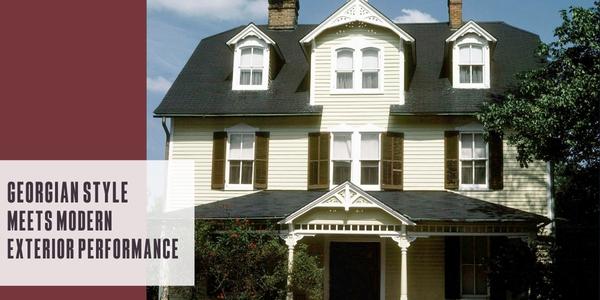
Georgian style meets modern exterior performance
By Jesse Sanchez.
A look at how vinyl siding and polymeric trim can preserve South Carolina’s architectural heritage while improving long-term performance.
Editor’s Note: This article is repurposed from an original piece by Don Browne, contributing writer and blogger for the Polymeric Exterior Products Association (PEPA), and first appeared in the trade association’s Imagine This newsletter in March 2026.
South Carolina’s Georgian-style architecture continues to define the character of its coastal communities, where historic design remains deeply embedded in the built environment. That enduring presence now intersects with a broader industry challenge: how to preserve architectural authenticity while adopting materials capable of meeting modern performance demands.
This intersection has made South Carolina a focal point for advocacy efforts led by the Polymeric Exterior Products Association (PEPA). Over the past two years, the organization has worked to build partnerships, educate stakeholders and advance legislation aimed at preventing local bans on vinyl siding and other modern exterior materials. According to PEPA, such restrictions extend beyond regulatory preference, limiting the ability of property owners and contractors to maintain and even enhance Georgian-style aesthetics using contemporary solutions.
That position is rooted in the history of the style itself. South Carolina’s Georgian architectural identity is closely tied to Irish architect James Hoban, who arrived in Charleston in the 1780s. His influence is visible in some of the city’s most prominent structures, including the Charleston County Courthouse, modeled after Dublin’s Leinster House. Hoban’s work gained national recognition following George Washington’s 1791 visit to Charleston, which led to an invitation to design the White House; a commission Hoban secured before later restoring the building after the War of 1812.
While that architectural legacy remains intact, the conditions surrounding it continue to challenge traditional construction methods. South Carolina’s climate, marked by sustained heat, humidity and periodic high winds, places ongoing stress on wood exteriors, often resulting in repeated cycles of maintenance, repainting and material replacement.
In response, PEPA points to vinyl siding and polymeric exterior systems as a practical extension of Georgian design rather than a departure from it. These materials are engineered to replicate defining architectural details, including cornice molding, pilaster bases and decorative window trim, while delivering improved durability, thermal movement, wind resistance and energy efficiency. Through its design resources, the association illustrates how these elements can be integrated in a way that maintains visual continuity while addressing long-term performance concerns.
As conversations around material restrictions continue, the issue increasingly centers on alignment rather than opposition, balancing preservation with performance. For contractors, designers and policymakers, that balance is shaping how Georgian architecture is sustained, adapted and built upon for the future.
Learn more about PEPA in their Coffee Shop Directory or on polymericexteriors.org.
About the author

Jesse is a writer for The Coffee Shops. When he is not writing and learning about the roofing industry, he can be found powerlifting, playing saxophone or reading a good book.
Recommended For You
Delivering durable, no-nonsense roof protection
Read More ...
SMP coating defies time and elements
Read More ...
SprayWorks launches new online store with 1,000's of spray foam and coatings products
Read More ...
UP TO THE MINUTE






Comments
Leave a Reply
Have an account? Login to leave a comment!
Sign In