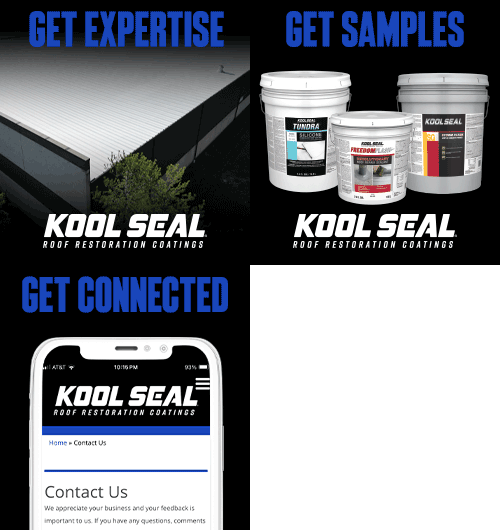









Not every roof should be coated

Restoration success starts with the right assessment.
Fluid-applied restoration has become an important option for extending roof service life, controlling capital costs and avoiding unnecessary tear-off. But one of the most important things contractors need to understand is that not every roof is a restoration candidate.
I’ve seen coatings used successfully for decades, and I’ve also seen them applied to roofs that should have been replaced. The difference usually comes down to what happened before anyone opened a bucket. Restoration begins with evaluating the roof, not selecting the coating.
A roof that is fundamentally sound, reasonably dry and still has serviceable components may be an excellent candidate for restoration. A roof with widespread moisture, deteriorated insulation, failing attachment or significant substrate damage usually tells a very different story. That distinction matters because a fluid-applied system can protect and extend an existing roof, but it cannot correct every underlying failure.
The first step should always be determining what condition the existing assembly is actually in. That means looking beyond the surface. A professional evaluation should consider membrane condition, seams, flashings, penetrations, drainage, previous repairs and areas showing signs of movement or deterioration. Moisture investigation may also be necessary because what appears acceptable on the surface may hide wet insulation or deck problems below. I've always believed that the most expensive coating job is the one installed over a roof that never should have been coated.
Localized deficiencies do not automatically eliminate restoration. In many cases, damaged areas can be removed and repaired, wet insulation can be replaced where appropriate and vulnerable details can be reinforced before the restoration system is installed. That is very different from trying to coat over systemic failure. Contractors need to recognize when the roof has crossed that line.
If moisture is widespread, the insulation has lost its integrity, the deck is deteriorated or the existing roofing system is no longer securely attached, replacement may provide better long-term value. The same can be true when years of repairs have created incompatible materials and questionable substrates across large portions of the roof. There comes a point when continuing to repair yesterday's problems costs more than properly resetting the roof assembly.
Substrate compatibility is another area where experience matters. Coatings perform differently depending on what they are being applied over. Existing membranes, modified bitumen, built-up roofing, metal and previously coated surfaces each present different preparation and adhesion requirements. Contamination, oils, oxidation, loose surfacing and aged repair materials can all affect performance.
This is why adhesion testing, proper cleaning and manufacturer requirements should never be treated as paperwork exercises. They help determine whether the proposed system can actually perform on that roof. Surface preparation may be one of the least glamorous parts of restoration, but it is also one of the most important.
You cannot coat dirt and expect long-term adhesion. You cannot ignore deteriorated seams and expect the coating to repair them on its own. And you cannot simply cover up trapped moisture and assume the problem is gone. A successful restoration project is built in layers. Repairs come first. Details are reinforced where required. Substrates are prepared properly. Primers are used when the system calls for them. Reinforcement and coating thickness are installed according to the specified assembly. The finished coating may be what everyone sees, but the work beneath the surface is often what determines performance.
Contractors also have a responsibility to help owners understand the difference between restoration and replacement. Restoration should never be presented as the cheaper version of reroofing. It is a different strategy for a roof that meets the right conditions. When those conditions exist, restoration can provide excellent value while reducing disruption and preserving useful components of the existing assembly. When those conditions do not exist, replacement may be the more responsible recommendation.
I've told contractors for years that sometimes the best way to sell coatings is to tell a customer when not to use them. That builds credibility. Owners remember the contractor who was willing to recommend the right solution instead of the easiest sale.
Fluid-applied restoration has earned an important place in modern roofing, but its success depends on disciplined evaluation and proper system selection. Good restoration contractors don't begin by asking, “Which coating should we use?” They begin by asking, “Should this roof be restored at all?”
Recommended For You
Building owners value honest conversations about roof lifespan
Read More ...
Restoration done right: Why evaluation and verification matter
Read More ...
The right conditions for coating
Read More ...
UP TO THE MINUTE







Comments
Leave a Reply
Have an account? Login to leave a comment!
Sign In