











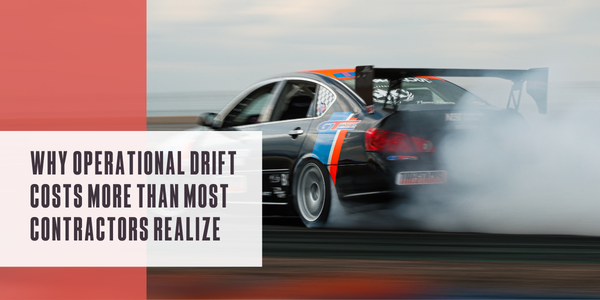
Why operational drift costs more than most contractors realize
By John Kenney, Cotney Consulting Group.
In roofing, companies rarely lose their edge overnight. More often...they slowly drift away from it.
One of the biggest challenges facing successful roofing companies isn't a lack of opportunity. It isn't finding work, investing in technology or even attracting good people. It's maintaining the operational discipline that made them successful in the first place.
I've watched companies grow from a handful of employees into organizations with multiple crews, several project managers and an impressive backlog of work. From the outside, they looked like success stories. Revenue was increasing. New customers were coming in. The business appeared healthy.
Then, almost without anyone noticing, things started to change. Project reviews became less consistent. Communication between departments became more informal. Jobsite visits happened a little less often. Purchasing decisions became rushed. Documentation slipped. Follow-up conversations that once happened automatically were postponed because everyone was busy.
None of those changes seemed significant at the time. Together, they changed the company.
I've come to believe that roofing companies rarely lose operational control because of one major event. They lose it through operational drift. Operational drift doesn't announce itself. It doesn't send an email or show up during a management meeting. It happens quietly. Processes that were once followed every time become "most of the time." Meetings that were once considered essential become optional. Once non-negotiable standards slowly become suggestions. The company continues moving forward, but the discipline that built its reputation begins fading in small, almost invisible ways.
That's what makes operational drift so dangerous. It feels harmless. One thing I've learned over the years is that people rarely wake up and decide to lower their standards. Good people don't intentionally create average companies. Operational drift happens because everyone is trying to solve today's problem. When the phones are ringing, projects are behind schedule and customers need answers, it's easy to convince yourself that you'll get back to the process later. The problem is that "later" tends to become permanent.
I've seen estimating reviews disappear because everyone was focused on bidding more work. I've seen project handoff meetings shortened until they eventually disappeared altogether. I've watched job cost reviews become quarterly discussions instead of the conversations that used to happen after every project. None of those decisions were made because leadership stopped caring. They were made because everyone believed they were saving time. In reality, they were borrowing problems from the future.
One observation has stayed with me throughout my career. Strong operations aren't built on extraordinary decisions. They're built on ordinary disciplines repeated consistently.
The daily habits that don't seem exciting are usually the ones protecting profitability. A project manager who follows up when they said they would. A superintendent who completes documentation before leaving the jobsite. An estimator who communicates assumptions instead of expecting others to figure them out. An owner who insists on reviewing projects even when the company is busy.
Those aren't extraordinary actions. They're operational disciplines. The strongest companies protect them because they understand something many organizations overlook. Consistency compounds. So does inconsistency.
Another mistake I see is assuming growth automatically means improvement. Growth creates opportunity, but it also magnifies weaknesses. A process that worked with two project managers may begin breaking down with six. Communication that felt natural in a twenty-person company becomes much more difficult when the organization reaches one hundred employees. Responsibilities become less clear. Decisions take longer.Information travels through more people. Without intentional structure, operational drift accelerates. That's why I often tell contractors that growth doesn't create operational problems. It exposes the ones that were already there.
I've also noticed that operational drift usually appears long before financial reports reveal it. Margins slowly become less predictable. Projects require more management attention. Crews spend more time waiting for decisions. Customers begin asking more questions. Leadership feels busier than ever but struggles to explain why. Those are operational warning signs. The financial results arrive later.
The companies that avoid operational drift have something in common. They periodically stop and ask themselves difficult questions:
- Are we still following the processes that made us successful?
- Have our standards changed without us realizing it?
- Are we solving problems — or simply becoming better at living with them?
Those conversations require honesty. They also require leadership.
One lesson I've carried with me over the years is that companies don't stay excellent by accident. Operational excellence has to be protected. Every process. Every expectation. Every standard. Not because people can'tbe trusted. Because organizations naturally drift toward whatever leadership consistently reinforces.
That's why culture matters. Culture isn't built by mission statements hanging on a wall. It's built by what leadership chooses to inspect, discuss and expect every single day. If leadership stops paying attention to the details, eventually everyone else will too.
The encouraging news is that operational drift is completely reversible. It doesn't require rebuilding the company. It requires reconnecting the organization with the disciplines that made it successful in the first place.Sometimes that means slowing down long enough to evaluate how work is actually being performed. Sometimes it means having conversations that should have happened months earlier. Sometimes it means simply refusing to accept "good enough" where excellence once existed.
The longer I've worked in this industry, the more convinced I've become that successful roofing companies don't outperform their competitors because they're constantly changing. They outperform them because they protect the habits, standards and operational disciplines that continue to produce predictable results year after year.
Because in roofing, companies rarely lose their edge overnight. More often...they slowly drift away from it.
Learn more about Cotney Consulting Group in their Coffee Shop Directory or visit www.cotneyconsulting.com.
Recommended For You

AI will not fix a broken process
Read More ...
Shifting your scope
Read More ...
Project closeout: The final 5% that protects 100% of your reputation
Read More ...
UP TO THE MINUTE







Comments
Leave a Reply
Have an account? Login to leave a comment!
Sign In