





Why the future of spray foam is about more than growth
By Dani Sheehan.
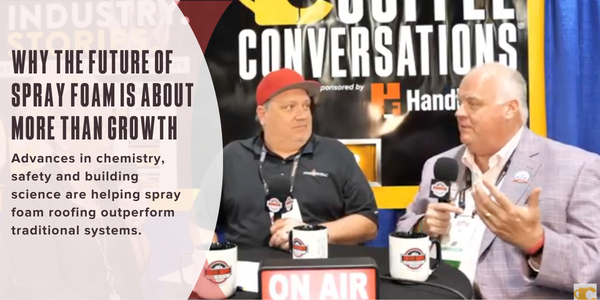
Advances in chemistry, safety and building science are helping spray foam roofing outperform traditional systems.
During a live Coffee Conversations® sponsored by Handifoam at the SprayFoam 2026 Convention and Expo, industry leaders Will Lorenz from General Coatings Manufacturing Corp and Josh Winkler of ICP Group delivered a clear message: spray foam roofing is no longer competing as an alternative system; it is evolving into a higher performing, more efficient solution designed to outperform traditional assemblies.
Innovation driving competitive systems
Today’s spray foam systems are being engineered for better performance, faster installs and stronger long-term value. As Will explained, “Our industry’s evolved to HFO technologies... They provide super efficiencies when you apply it. So, people are getting R-values of six to seven.” HFO (hydrofluoroolefin) blowing agents represent the latest generation of spray foam chemistry. Compared to older technologies, they deliver higher thermal performance with significantly lower environmental impact, particularly in terms of global warming potential (GWP).
Not only do these new standards help meet increasingly stringent energy codes and sustainability expectations, but they also improve jobsite efficiency. With R-values in the range of six to seven per inch, spray foam delivers more insulating power in less thickness, reducing the need for multiple layers or additional materials.
Advantages on the roof include:
- Simplified detailing around penetrations and irregular surfaces
- Reduced system weight compared to multi-layer assemblies
- Greater flexibility in recover and retrofit applications
Compared to traditional multi-layer assemblies that require boards, fasteners and membranes, spray foam systems are delivering higher thermal performance with fewer materials, fewer installation steps and fewer opportunities for failure.
Indoor air quality and sustainability
As spray foam expands into more interior applications, expectations around health, safety and environmental performance are rising. Josh highlighted how manufacturers are responding: “All the manufacturers are looking at lower VOC ratings... certifying that nothing harmful is being added in the indoor air environment.” Lower VOC formulations are especially important in tighter, more energy-efficient buildings, where air exchange is limited. Once cured, these products help ensure that insulation systems do not compromise indoor air quality.
Just as importantly, building owners are measuring system performance by more than upfront cost alone. Indoor air quality, energy efficiency and lifecycle durability are becoming key differentiators that spray foam can support. Spray foam contributes to long-term performance by:
- Reducing heating and cooling demand through superior insulation and air sealing
- Extending roof lifecycles when paired with coatings and maintenance
- Supporting recover systems that minimize tear-off waste
Fire safety and code compliance
As building codes evolve, particularly in wildfire-prone regions like California, spray foam manufacturers are proving that high-performance systems do not have to come at the expense of safety or design flexibility. Will explained how spray foam fits as part of the complete assembly when reducing fire risk: “We protect [the spray foam] with coatings...And we put it behind prescriptive thermal barriers. What we want to do is open up the design so that people can take advantage of putting insulation in and then use the right coating systems.” Intumescent and protective coatings are engineered to expand when exposed to heat, forming a protective layer that slows flame spread and enhances occupant safety.
Smarter, tighter buildings
Perhaps the biggest way spray foam is beginning to outperform traditional systems is through a fundamental shift in building science. Through initiatives supported by the Spray Foam Coalition, we’re starting to gain traction: “There's a smart way to build. There are smart products. There are manufacturers who support the fact that we don't always have to put on more insulation. We just design it, put in better products, work with the right manufacturers so the systems really perform and they outperform other insulation materials,” Will emphasized.
Air leakage remains one of the biggest drivers of energy loss in buildings. However, spray foam acts as both an insulator and an air barrier. As Josh trains the contractors he works with: “Seal it tight, ventilate right.” The idea is simple, but powerful:
- Create a tight building envelope by sealing gaps and penetrations
- Use mechanical systems to manage airflow and ventilation intentionally
Will and Josh’s message was clear: the future of spray foam roofing is about innovation. From next-generation chemistry and healthier indoor environments to fire-safe assemblies and smarter building design, spray foam is evolving to outperform traditional roofing systems at every level.
Learn more about APOC in their Coffee Shop Directory or visit www.apoc.com.
About the author

Dani is a writer for The Coffee Shops. When she's not writing or researching, she's exploring new hiking trails or teaching yoga classes.
Recommended For You

Improving the restoration experience
Read More ...
The importance of thinking outside the box
Read More ...
Coffee Conversations® brings experts together at IIBEC 2026
Read More ...
UP TO THE MINUTE






Comments
Leave a Reply
Have an account? Login to leave a comment!
Sign In